

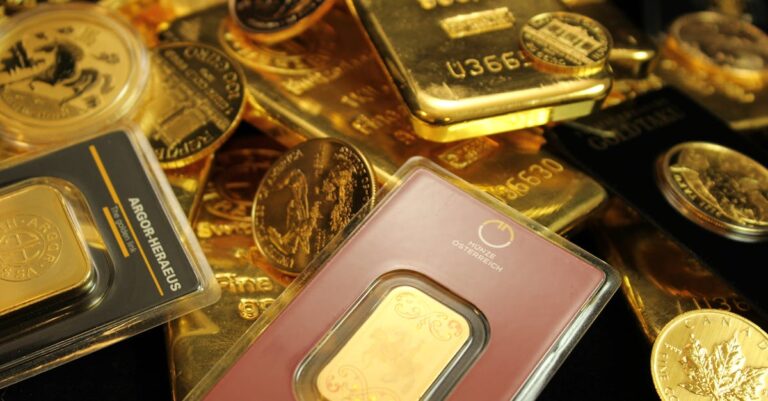
Recent gold and silver volatility sparks investor questions. This article deciphers market signals, forecasts price movements, and outlines strategies for precious metals investment.
The world of finance is rarely static, and the precious metals market offers a compelling testament to this truth. Investors in gold investment and silver have recently experienced a period of significant fluctuation, marked by a dramatic “liquidation dump” that saw gold plummet more than 3% and silver nearly 10% in a single day. This sharp correction, as reported by a trusted financial news outlet, sent ripples of concern through portfolios, raising critical questions about the immediate future of these traditional safe-haven assets. However, amidst the turmoil, signs of recovery have emerged, setting the stage for a crucial period influenced by upcoming economic data, most notably the Consumer Price Index (CPI).
This article aims to provide a comprehensive analysis of the current landscape for gold investment and silver, dissecting the forces at play and offering insights into potential price trajectories. We will delve into the nuances of market psychology, the influential role of economic indicators, and the technical patterns that could dictate the next major moves for these valuable commodities. Understanding these dynamics is paramount for any investor seeking to navigate the complexities of precious metals and make informed decisions on their journey to wealth accumulation.
Navigating the Turbid Waters of Precious Metals Investment
The recent market action serves as a potent reminder of the inherent volatility in commodities, even those traditionally considered stable stores of value. The term “liquidation dump” refers to a rapid sell-off, often triggered by investors needing to meet margin calls across various asset classes. When large institutions or individuals are forced to liquidate positions, it can create a cascading effect, driving prices down quickly and sharply. For many, witnessing such a rapid decline in their precious metals holdings can be disconcerting, sparking concerns about the stability of their gold investment.
However, the market’s immediate reaction also highlights the enduring appeal of gold as a defensive bet. Following the initial plunge, gold quickly began clawing its way back, demonstrating its intrinsic value as a haven asset. Similarly, silver, after its own steep decline, saw investors “on the hunt for bargains,” indicating a fundamental belief in its long-term potential. This immediate recovery underscores a key principle in precious metals investment: while susceptible to short-term shocks, their role as a safe harbor often prompts a swift return of demand.
Understanding the interplay between fear, forced selling, and underlying demand is crucial for any investor. These market movements are not merely arbitrary; they are the result of complex interactions between macroeconomic factors, investor sentiment, and technical trading patterns. By dissecting these elements, we can better anticipate future movements and strategically position our gold investment portfolios.
Economic Barometers: CPI, NFP, and Federal Reserve Policy
At the heart of the current precious metals market dynamics lies a suite of key economic indicators and the anticipated policy decisions of the central bank, particularly the Federal Reserve. These factors collectively exert a profound influence on the attractiveness of gold investment and silver, dictating their relative value against other assets, especially the US dollar.
The Critical Role of the Consumer Price Index (CPI)
All eyes are currently fixed on the January CPI print, which is widely forecast to register at 2.5%. The CPI is a measure that examines the weighted average of prices of a basket of consumer goods and services, such as transportation, food, and medical care. It is calculated by taking price changes for each item in the predetermined basket of goods and averaging them. Changes in the CPI are used to assess price changes associated with the cost of living.
For precious metals, particularly gold investment, the CPI is a pivotal indicator. Gold is often viewed as a hedge against inflation. When inflation rises, the purchasing power of fiat currencies erodes, making tangible assets like gold more appealing as a store of value. Conversely, lower inflation or deflationary environments tend to reduce gold’s allure as an inflation hedge.
A CPI reading of 2.5%, if confirmed, would provide crucial data points for investors and central bankers alike. It would offer insights into the ongoing battle against inflation and could influence expectations for future interest rate adjustments. A higher-than-expected CPI could signal persistent inflation, potentially bolstering gold’s appeal. A lower-than-expected reading might suggest inflation is under control, possibly tempering gold’s immediate upside.
Non-Farm Payrolls (NFP) and the Labor Market’s Influence
Prior to the CPI release, the market absorbed stronger-than-expected labor market data, with 130,000 jobs added. The Non-Farm Payrolls report is a comprehensive monthly statistic released by the U.S. Department of Labor, reflecting the total number of paid U.S. workers of any business, excluding general government employees, private household employees, and non-profit organization employees. It is a highly anticipated economic indicator that provides insights into the health of the U.S. economy.
A robust labor market, as indicated by strong NFP figures, typically signals economic strength. This strength can give the Federal Reserve more leeway to maintain higher interest rates or delay rate cuts without immediately fearing a recession. The recent 130,000 jobs added pushed expectations for the Fed’s first rate cut from June all the way to July 2026, according to a financial news report.
Higher interest rates generally make non-yielding assets like gold investment less attractive, as investors can earn a guaranteed return on interest-bearing assets such as bonds. Conversely, when interest rates are expected to fall, gold’s appeal tends to increase. Therefore, the NFP data, by influencing rate cut expectations, directly impacts the investment thesis for gold and silver.
Jobless Claims and Broader Economic Health
While the NFP provides a snapshot of job creation, initial jobless claims offer a real-time gauge of the labor market’s resilience. Initial claims recently registered at 227,000, slightly higher than market expectations. However, this figure still suggests a relatively healthy labor market that is not experiencing significant layoffs.
These employment figures, alongside other economic data, paint a picture of the overall economic health. A strong economy, with low unemployment and stable growth, can influence investor confidence, which in turn affects appetite for both risk assets and safe havens. For gold investment, a resilient economy can sometimes lead to reduced safe-haven demand if investors feel confident in traditional equity markets, but it also creates the conditions for potential inflation, which supports gold.
The US Dollar Index (DXY) and its Counterplay with Gold
The US Dollar Index (DXY) currently hovers around 97.05, holding firm due to the solid labor market data. The DXY measures the value of the United States dollar relative to a basket of foreign currencies. A stronger US dollar generally makes dollar-denominated commodities, like gold and silver, more expensive for holders of other currencies, potentially dampening demand.
There is typically an inverse relationship between the US dollar and gold prices. When the dollar strengthens, gold often weakens, and vice versa. This is because a stronger dollar reduces the relative cost of gold for international buyers, while a weaker dollar increases it. The delay in Fed rate cuts, driven by strong jobs data, has provided support for the US dollar, which in turn acts as a headwind for gold investment in the short term. Investors must constantly monitor the DXY as a key determinant of precious metals performance.
Global Sentiment: A Flight to Safety Amidst Fragile Confidence
Beyond domestic economic data, global risk sentiment plays a crucial role in shaping demand for safe-haven assets. The current environment is characterized by “super fragile” risk sentiment, with global equity indices, such as the Nikkei 225 and Hang Seng, closing in the red. This widespread cautiousness across international markets often translates into increased demand for traditional safe havens like gold investment.
When investors perceive heightened global economic uncertainty, geopolitical tensions, or financial instability, they tend to reallocate capital from riskier assets (like stocks) into perceived safer stores of value (like gold). This “flight to safety” provides a natural tailwind for gold prices, even in the face of other dampening factors. The current hesitation among investors to commit significant capital until the implications of the US inflation print are clear underscores this cautious sentiment.
This dynamic creates a fascinating tug-of-war for gold investment. On one side, a strong US dollar and delayed rate cuts exert downward pressure. On the other, elevated global risk aversion provides underlying support. The outcome of this contest often depends on which factor gains dominance in the collective investor psyche, a dominance frequently swayed by fresh economic data releases.
Gold (XAU/USD) Price Analysis: Eyeing the $5,000 Threshold
From a technical perspective, gold investment (XAU/USD) is currently navigating a critical juncture. The price is trading around $4,956 on the 4-hour chart, lingering just below the crucial $4,996 resistance level that previously acted as support. This flip from support to resistance is a significant technical indicator, suggesting that the previous floor has now become a ceiling that gold struggles to break through.
A descending trendline connecting the $5,598 swing high continues to cap short-term momentum, despite recent attempts at recovery. This trendline acts as a psychological and technical barrier, signifying that the broader trend remains bearish until a decisive break occurs. Furthermore, the 0.618 Fibonacci retracement level of $5,138 acts as an even broader hurdle for higher prices, reinforcing the challenges for a sustained uptrend.
Key Support and Resistance Levels for Gold Investment
Immediate support for gold is identified at $4,855. A failure to hold above this level could lead to a fall back towards $4,682, which corresponds to the 0.236 Fibonacci retracement. These support levels are critical for short-term traders and long-term investors alike, as they represent potential buying opportunities or signals for further downside.
Candlestick patterns also offer valuable insights. Repeated upper wicks near $5,000 signal significant selling pressure whenever gold attempts to rally towards this psychological and technical threshold. This indicates that a strong contingent of sellers is ready to offload their holdings at or near this price, creating resistance.
Moving Averages and Trend Confirmation
The 50-period moving average (MA) is slowly working its way towards $4,990, while the 200-MA remains lower, around $4,780. Moving averages provide a smoothed representation of price data over a specified period, helping to identify trends. The 50-period MA tracking close to resistance suggests that short-term momentum is still struggling to establish a strong bullish trend.
The fact that the 200-MA is still holding low indicates that the medium-term structure for gold investment remains relatively intact, meaning the longer-term trend may not have entirely turned bearish, but the immediate path is challenging. A break above $4,996 would be a strong bullish signal, potentially triggering a move towards the more significant $5,138 resistance. Conversely, a failure to hold above $4,855 would open the door for a more substantial pullback.
Gold Investment Trade Idea and Risk Management
Based on the technical analysis provided by a market expert, a potential trade idea for gold investment is to “go long above $5,005 and aiming for $5,135 with a stop-loss below $4,880.” This strategy assumes a bullish breakout above key resistance. Going long means buying with the expectation that the price will rise. The target of $5,135 represents a significant resistance level, while the stop-loss below $4,880 is a crucial risk management tool designed to limit potential losses if the trade does not go as expected. For every trade, defining entry, target, and stop-loss points is fundamental for capital preservation.
Silver (XAG/USD) Price Analysis: Rebound Capped Near $80
Silver (XAG/USD), often referred to as “poor man’s gold” but with its own distinct market dynamics, is currently trading around $76.70 on a 4-hour chart. It experienced an even sharper tumble than gold, plunging from its $80.11 resistance point. Like gold, silver is also stuck below a descending trend line, drawn from a previous high of $106.60. This long-term descending trendline suggests that the overall picture for silver remains corrective, despite recent stabilization.
The behavior of candlesticks revealed strong downward momentum earlier in the week, pushing prices towards $70.37, before a recovery began forming higher lows. However, similar to gold, the upper wicks on these recovery candles consistently get “knocked back” near $80. This indicates persistent selling pressure whenever silver approaches this level, hindering a sustained upward move.
Key Support and Resistance Levels for Silver Investment
The 50-period moving average for silver is now sloping downward at around $84, while the 200-day MA is stubbornly stuck around $86. Both moving averages are above the current price, acting as overhead resistance and reinforcing the bearish outlook for the immediate term. If selling pressure resumes, immediate support for silver is expected at $72.00. A breach of this level could lead to a significant slide down to $70.37, representing a key psychological and technical support zone.
Silver Investment Trade Idea and Considerations
The suggested trade idea for silver is to “get short below $76.00, targeting a stop around $72.00 but placing your stop above $80.20.” Going short means selling an asset with the expectation that its price will fall. The target of $72.00 aligns with a significant support level, while the stop-loss above $80.20 aims to protect against unexpected upward reversals. This strategy reflects the expert’s view of continued downward pressure for silver.
It is important for investors to remember silver’s dual nature: it is both a precious metal and an industrial commodity. Its industrial demand component means it can be more sensitive to global economic growth prospects than gold. This can introduce additional layers of volatility and complexity for silver investment strategies.
Strategic Considerations for Precious Metals Investment
Investing in precious metals like gold and silver requires a strategic approach that goes beyond short-term forecasts. While technical analysis and economic indicators provide valuable insights into immediate price movements, a successful precious metals investment strategy integrates these with broader financial goals and risk tolerance.
Diversification and Portfolio Resilience
One of the primary reasons investors include gold and silver in their portfolios is for diversification. Precious metals often move independently, or even inversely, to other asset classes like stocks and bonds, particularly during periods of market stress. This characteristic makes them valuable tools for enhancing portfolio resilience and potentially reducing overall risk.
A well-diversified portfolio might include a percentage allocated to physical gold or silver, or exposure through exchange-traded funds (ETFs) and other financial instruments. The appropriate allocation will vary based on individual circumstances, but the principle of not putting all your eggs in one basket remains paramount.
Long-Term Wealth Preservation
Beyond short-term trading opportunities, many investors view gold investment as a cornerstone for long-term wealth preservation. Throughout history, gold has maintained its purchasing power, serving as a hedge against inflation and currency debasement. In an era of expansive monetary policies and geopolitical uncertainties, this role becomes even more pronounced.
Silver, while more volatile due to its industrial uses, also offers similar long-term wealth preservation attributes, albeit with greater potential for price swings. For those looking to protect their purchasing power over decades, a measured and consistent allocation to precious metals can be a prudent strategy.
Understanding Market Psychology and Behavioral Finance
The recent “liquidation dump” vividly illustrates the impact of market psychology. Fear, panic, and the pressure of margin calls can lead to irrational selling. Conversely, the “hunt for bargains” after a sharp decline demonstrates the psychological pull of perceived value. As noted by financial expert Arslan Ali, whose background includes an MPhil degree in behavioral finance, understanding investor psychology is key to deciphering market sentiment and identifying overbought or oversold conditions.
Successful investors often train themselves to counteract emotional impulses, adhering to their pre-defined investment plans even when the market is chaotic. This involves setting clear entry and exit points, maintaining appropriate stop-losses, and resisting the urge to chase rapid gains or panic sell during downturns. Discipline is a golden rule in gold investment.
Consulting with Financial Professionals
Given the complexity of macroeconomic factors, technical analysis, and individual financial circumstances, consulting with a qualified financial advisor is highly recommended. A professional can help assess your risk tolerance, establish clear financial goals, and construct a diversified portfolio that includes precious metals in a manner that aligns with your overall wealth strategy. They can provide tailored advice on navigating volatile markets and making informed decisions about your gold investment.
In conclusion, the precious metals market is currently a dynamic arena, shaped by a confluence of economic data, central bank policy expectations, and global sentiment. While recent plunges have tested investor resolve, the underlying demand for gold and silver as safe havens remains strong. As the market awaits the pivotal CPI data, strategic investors will continue to monitor key technical levels and macroeconomic developments, leveraging insights to protect and grow their wealth. The path to $5,000 for gold, while challenging, is certainly within view, provided the economic winds blow favorably and investor confidence holds.
Frequently Asked Questions
How do CPI reports impact my gold investment decisions?
The Consumer Price Index (CPI) is a key inflation indicator. Gold is often seen as a hedge against inflation because its value tends to rise when the purchasing power of fiat currencies declines. A higher-than-expected CPI report can signal persistent inflation, making gold more attractive and potentially driving up its price, aiding your gold investment strategy. Conversely, a lower CPI might temper gold’s appeal. Monitoring CPI helps investors anticipate potential shifts in gold demand and price.
What does the recent gold price plunge mean for long-term investors worried about losses?
While a 3% gold plunge can be concerning, for long-term investors, it’s often viewed as short-term volatility. Gold’s role as a safe-haven asset and a store of value against inflation typically holds over extended periods. Such “liquidation dumps” can sometimes present buying opportunities for those looking to accumulate gold at a lower price. Long-term investors should focus on their overall portfolio diversification and the fundamental reasons for their gold investment, rather than reacting to daily fluctuations.
Is silver a better investment than gold given its recent volatility and potential for rebound?
Silver’s recent sharp decline and subsequent rebound highlight its higher volatility compared to gold. Silver functions both as a precious metal and an industrial commodity, making its price more sensitive to economic growth. While it offers potential for greater gains during bull markets, it also carries higher risk during downturns. The choice between silver and gold investment depends on an individual’s risk tolerance, investment horizon, and specific market outlook. Many investors choose to hold both for diversification.
How can I protect my precious metals investment from sudden market “liquidation dumps”?
Protecting your precious metals investment from sudden drops like liquidation dumps involves several strategies. Firstly, maintaining a diversified portfolio ensures that no single asset class jeopardizes your entire wealth. Secondly, using stop-loss orders if you are actively trading can limit potential losses. For long-term investors, dollar-cost averaging can mitigate the risk of buying at peak prices. Finally, understanding market psychology and avoiding emotional reactions to short-term volatility are crucial for safeguarding your gold investment over time.
What role do interest rate expectations play in gold and silver prices, and how does it affect my investment?
Interest rate expectations significantly influence gold and silver prices. When interest rates are expected to rise or remain high, non-yielding assets like precious metals become less attractive compared to interest-bearing assets (e.g., bonds). Conversely, expectations of lower interest rates tend to boost the appeal of gold and silver. The recent delay in Federal Reserve rate cut expectations to July 2026, driven by strong jobs data, has supported the US dollar, which acts as a headwind for gold investment. Keeping an eye on central bank announcements and economic data is vital for understanding this dynamic.