

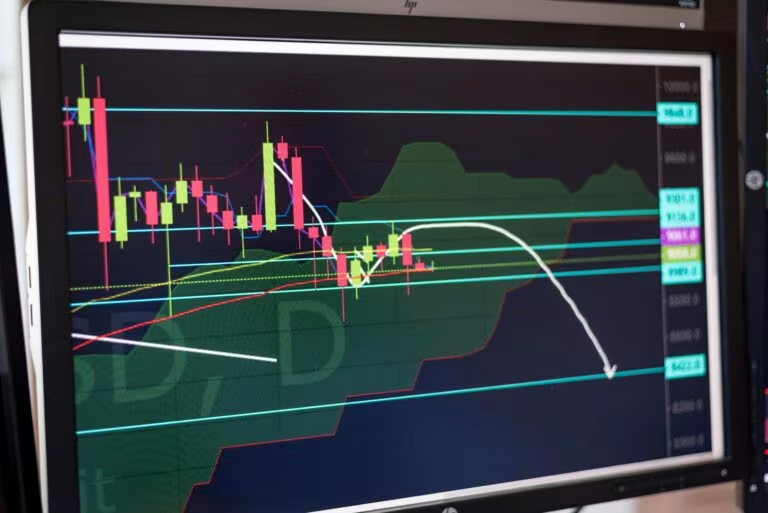
Feeling lost in market noise? This guide demystifies economic signals, transforming complex data into actionable insights for robust, long-term wealth building, perfect for the prudent investor.
In the dynamic world of personal finance, the journey from work to wealth is rarely a straight line. It’s often influenced by a myriad of factors, some predictable, others less so. For many aspiring wealth builders, the sheer volume of daily financial news, market updates, and expert opinions can be overwhelming. Headlines scream about market fluctuations, interest rate changes, and global economic shifts, leading to confusion rather than clarity. How does one discern what truly matters for their long-term financial goals amidst this cacophony? The answer lies in understanding and judiciously interpreting economic signals for wealth building.
At ‘Work to Wealth’, our focus is on sustainable growth, informed decision-making, and building a resilient financial future, not on chasing short-term market fads or reacting to every daily tremor. While specific trading signals might dominate financial news channels, a broader, more strategic understanding of underlying economic forces is paramount for anyone serious about accumulating and preserving wealth over decades. This article will delve into the critical economic indicators that truly influence your portfolio and overall financial health, explaining how to translate these insights into a robust, enduring wealth-building strategy. We’ll explore how these signals, often seen as complex, can become powerful tools in your arsenal, guiding you toward informed choices and away from impulsive reactions.
What Are Economic Signals and Why Do They Matter for Wealth?
At their core, economic signals for wealth are data points and trends that provide insights into the health, direction, and momentum of an economy. These aren’t just abstract numbers; they are reflections of real-world activity – how businesses are performing, how consumers are spending, and how governments and central banks are managing monetary policy. For a day trader, these signals might dictate a buy or sell order within hours. For the long-term wealth builder, however, they paint a much larger picture, informing strategic asset allocation, risk management, and overall portfolio resilience.
Consider the difference between reading a single word and understanding an entire novel. A daily market signal is like a single word; it offers immediate, localized meaning. Economic signals, when viewed collectively and over time, are the narrative of the global economy. They explain why interest rates might rise, impacting your mortgage and bond investments, or why inflation might erode your savings’ purchasing power, necessitating a shift in your investment strategy. Ignoring these signals is akin to navigating a ship without a compass – you might drift aimlessly or, worse, steer directly into a storm.
These signals transcend national borders, influencing global markets and thus the value of your international holdings or the purchasing power of your domestic currency. Understanding them allows you to anticipate potential shifts, make proactive adjustments, and safeguard your wealth against unforeseen economic turbulence. They help you align your personal financial goals with the broader economic currents, ensuring your investment choices are not just reactive but strategically forward-looking. This analytical approach, rather than speculative trading, is fundamental to the ‘Work to Wealth’ philosophy.
Beyond the Daily Headlines: A Long-Term Investor’s View
The financial media often thrives on immediacy and drama. Every uptick or downtick is presented as a major event, every analyst’s prediction as gospel. While this can be engaging, it’s frequently counterproductive for the long-term investor. The investor focused on building wealth understands that daily market noise, including specific currency pair signals like the GBP/USD’s short-term movements, are often irrelevant to their multi-decade journey. These fleeting fluctuations are typically driven by short-term sentiment, algorithmic trading, or isolated events, rather than fundamental economic shifts.
For the ‘Work to Wealth’ community, the focus shifts from predicting tomorrow’s market close to understanding the underlying economic tides that move entire sectors, asset classes, and global regions over months and years. Instead of fixating on a single market signal, a prudent investor examines a confluence of economic signals for wealth, looking for consistent patterns and directional strength. For instance, a temporary dip in a stock market might cause alarm for a day trader, but a long-term investor might see it as a buying opportunity if the fundamental economic indicators remain strong. Conversely, a brief surge might be a signal to take some profits if broader economic headwinds are gathering.
The key is to develop a filter, to distinguish between transient market chatter and truly significant economic data that impacts long-term investment prospects. This involves understanding the lagging, coincident, and leading nature of various indicators. It means cultivating patience and discipline, resisting the urge to react to every headline, and instead, letting a well-researched, economically informed strategy guide your decisions. This approach allows you to harness the power of compounding and time, rather than falling prey to the emotional rollercoaster of daily market swings.
Key Economic Indicators Every Wealth Builder Should Monitor
To effectively leverage economic signals for wealth, it’s crucial to identify and understand the most impactful indicators. These aren’t obscure academic metrics but rather regularly published reports that offer a pulse check on the economy. While the list below is not exhaustive, it covers the primary data points that provide a comprehensive view for the long-term investor.
Gross Domestic Product (GDP): The Economy’s Report Card
Gross Domestic Product (GDP) is arguably the most fundamental measure of a country’s economic health. It represents the total monetary value of all finished goods and services produced within a country’s borders during a specific period, usually a quarter or a year. Think of it as the economy’s report card. A rising GDP generally indicates economic expansion, higher corporate profits, and potentially a stronger job market, all of which are positive for equity investments.
Conversely, a contracting GDP, especially over two consecutive quarters, signals a recession, which can lead to lower corporate earnings, higher unemployment, and a more challenging investment environment. For wealth builders, monitoring GDP growth rates helps in understanding the broader economic cycle. During periods of robust growth, certain sectors (like technology or consumer discretionary) might thrive, while slower growth might favor more defensive sectors (like utilities or consumer staples). Understanding GDP also helps gauge the overall risk appetite in the market; a strong economy typically supports higher risk-taking, while a weak one encourages caution.
Inflation Rates: Preserving Purchasing Power
Inflation, typically measured by indices like the Consumer Price Index (CPI) or the Producer Price Index (PPI), quantifies the rate at which the general level of prices for goods and services is rising, and consequently, the purchasing power of currency is falling. For wealth builders, inflation is a silent thief. If your investments aren’t generating returns that outpace inflation, your real wealth is actually diminishing. For example, if inflation is 3% and your savings account yields 1%, you’re losing 2% of your purchasing power annually.
High inflation can lead central banks to raise interest rates, impacting bond prices and borrowing costs. It can also squeeze corporate profit margins if companies cannot pass on higher costs to consumers. Monitoring inflation is crucial for making strategic decisions about asset allocation. During periods of rising inflation, investors might seek refuge in inflation-protected securities, real estate, commodities, or dividend-paying stocks that can adjust their prices. Understanding inflation is a vital component of protecting and growing your economic signals for wealth against erosion.
Interest Rates and Central Bank Policies: The Cost of Money
Interest rates, particularly those set by central banks (like the federal funds rate in some major economies), are powerful levers that influence the entire financial system. They determine the cost of borrowing for businesses and consumers, affecting everything from mortgage rates to corporate expansion plans. When central banks raise interest rates, they typically aim to cool down an overheating economy and curb inflation. This can make borrowing more expensive, slowing economic activity, and often leads to lower stock valuations (as future earnings are discounted at a higher rate) and higher bond yields (meaning existing bonds with lower yields become less attractive).
Conversely, when central banks lower rates, they seek to stimulate economic growth. This makes borrowing cheaper, encouraging spending and investment, which can boost stock markets and make bond returns less appealing. For wealth builders, understanding the direction of interest rates is critical for managing bond portfolios, assessing real estate investments, and evaluating the attractiveness of growth versus value stocks. Changes in interest rate policy are among the most impactful economic signals for wealth accumulation, directly affecting the returns on various asset classes and the cost of capital.
Employment Data: A Barometer of Economic Health
Employment data provides a direct snapshot of the labor market’s health, which is a key determinant of consumer spending and overall economic vitality. Key metrics include the unemployment rate, non-farm payrolls (NFP), initial jobless claims, and wage growth. A strong job market, characterized by low unemployment and rising wages, indicates that consumers have more disposable income, leading to increased spending and supporting economic growth. This is generally a positive signal for corporate earnings and equity markets.
Conversely, a weakening job market with rising unemployment and stagnant wages can signal an impending economic slowdown or recession. This can lead to reduced consumer spending, lower corporate profits, and a more cautious investment climate. Central banks also closely watch employment data when making decisions about interest rates. Strong employment figures might prompt a central bank to consider raising rates to prevent inflation, while weak figures might lead to rate cuts to stimulate the economy. For wealth builders, employment data offers invaluable economic signals for wealth by indicating the strength of consumer demand and the overall economic backbone.
Purchasing Managers’ Index (PMI) and Currency Fluctuations: Leading Insights & Global Impact
The Purchasing Managers’ Index (PMI) is a leading indicator for the economic health of the manufacturing and services sectors. Compiled from surveys of purchasing managers, it tracks new orders, production, employment, and inventories. A PMI reading above 50 generally indicates expansion, while a reading below 50 suggests contraction. Because purchasing managers are often the first to see changes in demand, the PMI offers a forward-looking perspective, making it a valuable tool for anticipating broader economic shifts.
Closely related to global economic health and trade are currency fluctuations. While often associated with short-term forex trading, currency movements (like those for GBP/USD) have significant implications for long-term wealth builders. A strong domestic currency makes imports cheaper and can reduce the competitiveness of exports, potentially impacting multinational corporations within your portfolio. Conversely, a weaker domestic currency makes exports more attractive and can boost the earnings of companies with significant international sales. For investors holding international assets, currency fluctuations directly affect the value of those assets when converted back to their home currency. For instance, if you own shares in a company based in a country whose currency depreciates against yours, the value of your investment might decrease even if the company’s stock price remains stable in its local currency. Understanding these global interdependencies is a critical part of interpreting comprehensive economic signals for wealth, especially in a diversified portfolio.
Translating Signals into Investment Strategy
Understanding economic signals is only half the battle; the other half is knowing how to translate them into actionable investment strategies. This doesn’t mean constantly tinkering with your portfolio, but rather making informed, periodic adjustments that align with the prevailing economic environment and your long-term goals.
Portfolio Allocation Based on Economic Cycles
Economic cycles—expansion, peak, contraction, trough—are significantly influenced by the indicators discussed. Different asset classes and sectors perform better during different phases. During an economic expansion, growth stocks, technology, and consumer discretionary sectors tend to thrive. As the economy peaks and inflation concerns rise, value stocks, commodities, and real estate might become more attractive. During a contraction or recession, defensive sectors like utilities, healthcare, and consumer staples, along with high-quality bonds, tend to offer more stability. By monitoring economic signals for wealth like GDP growth, inflation, and employment, you can strategically adjust your portfolio’s allocation to take advantage of these cyclical trends, without trying to time the market perfectly.
Geographic Diversification and International Investments
Economic signals are not uniform across the globe. While one region might be experiencing robust growth, another could be facing a slowdown. This divergence provides opportunities for geographic diversification. If domestic economic signals suggest an impending slowdown, for instance, you might consider increasing exposure to international markets with more favorable growth prospects. Similarly, understanding currency trends, influenced by a country’s economic health and interest rate differentials, is crucial for international investors. A strong foreign economy might make its currency appreciate, boosting your returns when repatriating funds. Therefore, global economic insights gleaned from various economic signals for wealth inform a truly diversified and resilient portfolio.
Inflation Hedging Strategies
When inflation signals become pronounced, taking proactive steps to hedge against its erosive effects is vital. This can involve increasing your allocation to inflation-protected securities (such as government-issued bonds designed to adjust for inflation), real estate (which often acts as a hedge due to rising property values and rental income), commodities (like gold or oil, whose prices tend to rise with inflation), or even specific types of dividend-paying stocks that have pricing power to pass on higher costs. Incorporating these inflation-aware strategies ensures that your purchasing power is maintained, a key component of long-term wealth preservation and growth, directly informed by economic signals for wealth related to price changes.
Interest Rate Sensitivity in Asset Selection
The direction of interest rates has a direct impact on bond prices and the valuation of interest-sensitive assets. As interest rates rise, existing bonds with lower yields become less attractive, and their market value typically falls. Conversely, falling interest rates generally boost bond prices. For equities, higher interest rates can increase borrowing costs for companies, potentially reducing profit margins, and also make future earnings streams less valuable when discounted back to the present. Growth stocks, which rely heavily on future earnings, can be particularly sensitive. Understanding the central bank’s stance and the trajectory of rates, guided by various economic signals for wealth, allows you to adjust your exposure to fixed-income assets and select equities that are better positioned for the prevailing interest rate environment.
The Pitfalls of Obsessing Over Short-Term Signals
While understanding economic signals for wealth is crucial, there’s a significant difference between being informed and being obsessed. The trap many investors fall into is attempting to ‘time the market’ by reacting to every single data release or expert prediction. This often leads to over-trading, higher transaction costs, and ultimately, poorer returns than a disciplined, long-term approach.
Short-term market signals, such as daily currency pair movements or intra-day stock price fluctuations, are inherently noisy and unpredictable. They can be influenced by transient news, algorithmic trading, or purely speculative activity that has little bearing on the fundamental value of an asset or the long-term health of an economy. Attempting to profit from these fleeting movements is often a zero-sum game, requiring a level of precision and foresight that few possess consistently. For the ‘Work to Wealth’ ethos, this kind of activity is a distraction from the core principles of patient capital growth.
Furthermore, constant monitoring and reactive decision-making can lead to emotional investing. Fear and greed are powerful drivers that can cause investors to sell low during downturns or buy high during speculative bubbles. A disciplined approach, grounded in a solid understanding of broader economic trends, helps to mitigate these emotional biases. It reinforces the importance of patience, sticking to a well-defined investment plan, and allowing the power of compounding to work its magic over time, rather than chasing every fleeting market signal.
Building a Resilient Portfolio with Economic Awareness
The ultimate goal of understanding economic signals for wealth is to build a portfolio that can withstand various market conditions and consistently grow over the long term. This requires a strategic mindset and adherence to core investment principles.
Importance of a Diversified Portfolio
Diversification remains the cornerstone of a resilient portfolio. By spreading investments across different asset classes (stocks, bonds, real estate, commodities), sectors, geographies, and investment styles, you reduce the impact of poor performance in any single area. Economic signals provide the insights to strategically diversify. For example, if signals point to rising inflation, diversifying into inflation-hedging assets makes sense. If one region’s economy shows signs of stress, having exposure to more robust economies globally mitigates risk. This broad approach, informed by comprehensive economic data, helps smooth out returns and provides a more stable growth trajectory.
Regular Portfolio Rebalancing
As market conditions and economic signals evolve, your portfolio’s original asset allocation might drift. Rebalancing is the process of periodically adjusting your portfolio back to its target asset allocation. For instance, if equities have performed exceptionally well, they might now constitute a larger portion of your portfolio than initially intended. Rebalancing involves selling some of the overperforming assets and buying more of the underperforming ones to restore the desired proportions. This systematic approach, rather than emotional buying or selling, ensures your portfolio remains aligned with your risk tolerance and long-term financial goals, leveraging economic signals for wealth without being overly reactive.
Avoiding Emotional Decisions and Maintaining Discipline
One of the biggest threats to wealth accumulation is succumbing to emotional decision-making. Market downturns can induce panic, leading investors to sell at a loss, while exuberant bull markets can foster greed, prompting speculative buys. Economic signals, when understood objectively, provide a rational framework for decision-making, helping to counteract these emotional impulses. By having a clear understanding of the underlying economic trends and their long-term implications, you can maintain discipline, stick to your investment plan, and avoid impulsive actions that often erode wealth. The ‘Work to Wealth’ philosophy champions this disciplined, patient approach.
Consulting with Financial Advisors
For many, navigating the complexities of economic signals for wealth and translating them into a personalized strategy can be challenging. This is where the expertise of a qualified financial advisor becomes invaluable. An advisor can help interpret complex data, assess your individual risk tolerance and financial goals, and construct a diversified portfolio tailored to your needs. They can provide an objective perspective, helping you avoid common pitfalls and stay focused on your long-term objectives, ensuring your wealth-building journey is both informed and strategically managed.
The Future of Economic Signals and Your Wealth Journey
The global economic landscape is in constant flux, shaped by technological advancements, geopolitical shifts, and evolving consumer behaviors. The way we interpret and utilize economic signals for wealth building will continue to evolve as well. The rise of big data and artificial intelligence promises even more sophisticated tools for economic analysis, potentially offering deeper insights and more nuanced understandings of market dynamics. However, the fundamental principles of sound investing, grounded in a long-term perspective and an awareness of core economic forces, will remain timeless.
For the wealth builder of tomorrow, the challenge will not be a lack of information, but rather the ability to filter and interpret the truly meaningful signals from the ever-increasing noise. Cultivating a critical mindset, understanding the underlying drivers of economic change, and prioritizing strategic planning over short-term speculation will be more crucial than ever. The journey from work to wealth is a marathon, not a sprint, and informed decision-making, guided by a thoughtful analysis of economic signals, will be your most reliable compass.
Ultimately, embracing economic signals as tools for strategic insight—rather than as triggers for reactive trading—empowers you to take control of your financial destiny. It transforms you from a passive observer of market movements into an active participant in your wealth’s growth, making informed choices that align with a robust, enduring vision for your financial future. This proactive and educated approach is precisely what ‘Work to Wealth’ advocates for every individual committed to building lasting prosperity.
Frequently Asked Questions
How can I stop feeling overwhelmed by daily market news when trying to build wealth?
To combat overwhelming daily market news, focus on understanding broader economic signals for wealth building rather than short-term market fluctuations. Distinguish between ‘noise’ (daily price movements, speculative opinions) and fundamental economic data (GDP, inflation, employment). Prioritize long-term trends and resist the urge to react to every headline. Develop a clear investment plan and stick to it, using significant economic shifts as a prompt for strategic review, not impulsive changes. A disciplined, patient approach helps filter irrelevant information and keeps you focused on your long-term financial goals.
What are the essential economic signals for growing a long-term investment portfolio?
Key economic signals for growing a long-term investment portfolio include Gross Domestic Product (GDP) for overall economic health, inflation rates (CPI, PPI) to protect purchasing power, central bank interest rate policies for asset valuation, and employment data (non-farm payrolls, unemployment rate) for consumer spending insights. Additionally, the Purchasing Managers’ Index (PMI) offers leading insights into economic activity, and understanding currency fluctuations impacts international holdings. Monitoring these comprehensive economic signals for wealth allows for informed strategic adjustments to your portfolio.
Do currency fluctuations really impact my domestic investment returns, causing frustration?
Yes, currency fluctuations can indeed impact your investment returns, even for seemingly domestic portfolios, and can be a source of frustration if not understood. For instance, if you invest in multinational companies that generate a significant portion of their revenue overseas, a strong domestic currency can reduce the value of those international earnings when converted back. Conversely, a weaker domestic currency can boost them. For direct international investments, currency movements directly affect the value of your assets when converted to your home currency. Understanding how these economic signals for wealth work allows you to factor them into your overall diversification and risk management strategy.
How can I adapt my investment strategy using economic signals to preserve wealth during inflation?
To preserve wealth during inflation, adapt your investment strategy by focusing on assets that traditionally perform well in inflationary environments. This includes increasing exposure to inflation-protected securities, real estate (due to rising property values and rental income), commodities (like precious metals or energy), and dividend-paying stocks of companies with strong pricing power. These assets tend to offer a hedge against the erosion of purchasing power. Monitoring inflation-related economic signals for wealth, such as the Consumer Price Index (CPI), will guide these strategic allocation adjustments.
Is it better to follow specific trading signals or understand broader economic signals for wealth?
For long-term wealth building, it is generally far more effective to understand broader economic signals for wealth than to follow specific, short-term trading signals. While trading signals might aim for quick gains, they often involve higher risk, transaction costs, and require precise timing that few can achieve consistently. Broader economic signals (like GDP, inflation, and interest rates) provide a strategic framework for asset allocation and risk management, fostering sustainable growth and helping you avoid emotional decisions. The ‘Work to Wealth’ philosophy emphasizes this long-term, informed approach over speculative trading.