

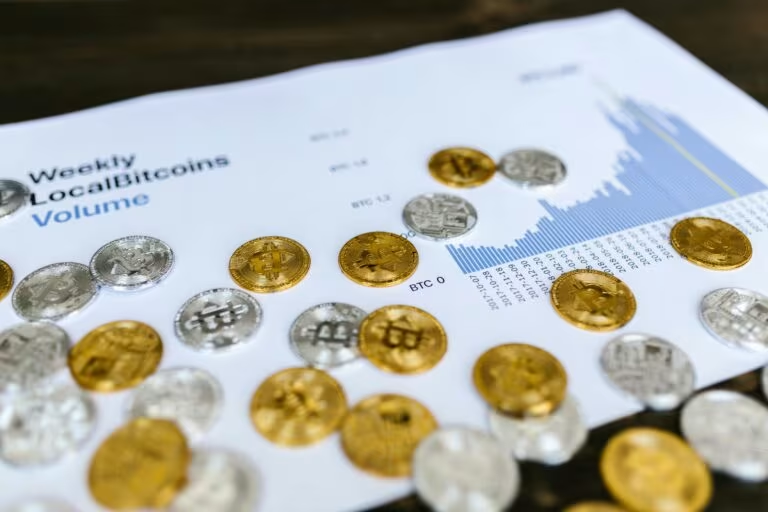
Navigating volatile Bitcoin prices? Understand how Federal Reserve interest rate decisions impact your crypto portfolio and strategies for long-term wealth building.
The financial markets are a complex ecosystem, constantly reacting to a multitude of factors. Among the most influential forces in this ecosystem is the Federal Reserve, often referred to simply as “the Fed.” Its decisions, particularly concerning interest rates, ripple through every asset class, from traditional stocks and bonds to the relatively newer and often more volatile realm of digital assets like Bitcoin. Investors, both seasoned and novice, frequently find themselves grappling with uncertainty as they attempt to decipher how the Fed’s stance might affect their Bitcoin holdings and broader financial aspirations.
In recent times, Bitcoin has experienced significant price fluctuations. As financial reports indicate, the leading digital currency has seen periods of substantial declines from its previous all-time highs, causing considerable anxiety among those who have invested in it. This market sentiment, characterized by a shift towards risk aversion, can be attributed to several factors, including significant market events that trigger large liquidations and subsequently reduce overall market liquidity. The general sentiment, as often measured by various market indices, has swung between fear and extreme fear, highlighting the apprehension many investors feel.
A pivotal moment that frequently captures the market’s attention is the Federal Reserve’s upcoming interest rate decision. These decisions are not merely technical adjustments; they are statements on the health of the economy, inflation, and employment, and they carry immense weight. For digital assets, specifically Bitcoin, the anticipated impact of these decisions is a subject of intense debate and speculation. While rate adjustments are often viewed as direct drivers for market movements, the reality is far more nuanced. The market often “prices in” anticipated changes, meaning that much of the expected impact might already be reflected in current asset valuations. Therefore, the actual decision itself can sometimes have less impact than the forward-looking commentary accompanying it.
The Mechanics: How Interest Rate Cuts Influence Bitcoin Prices
To fully grasp the intricate relationship between Fed decisions and Bitcoin prices, it’s essential to delve into the fundamental economic principles at play. Interest rates are the cost of borrowing money and the return on saving money. When the Fed cuts interest rates, it typically signals a desire to stimulate economic growth. This policy action creates a cascade of effects across financial markets:
- Reduced Yields on Safer Investments: Lower interest rates diminish the returns offered by traditional, low-risk assets such as government bonds, savings accounts, and money market funds. For investors seeking higher returns, these safer options become less attractive. This often prompts a reallocation of capital towards assets perceived to offer greater growth potential, even if they come with increased risk.
- Increased Liquidity: Lower borrowing costs encourage businesses and consumers to take on more debt for investments and spending. This injection of capital into the economy, often referred to as “liquidity,” means there is more money “sloshing around” in the financial system. A significant portion of this increased liquidity can find its way into riskier assets, including digital currencies.
- Stimulus for Risk-Taking: When the cost of capital is low, the perceived risk of investing in volatile assets can seem more manageable, or at least the opportunity cost of not investing in them becomes higher. This can shift overall market sentiment from “risk-off” to “risk-on,” where investors become more comfortable taking on higher levels of risk in pursuit of greater gains.
These dynamics were clearly observable during periods of extremely low interest rates, such as those following major economic downturns. During these times, Bitcoin, along with other high-growth assets, often saw significant appreciation as investors sought alternatives to stagnant returns in traditional markets. However, it’s crucial to understand that while rate cuts can be a tailwind for Bitcoin, they are rarely the sole catalyst for a sustained rally, especially if the market has already factored in the likelihood of such a cut. The market is forward-looking, and if a rate cut is widely anticipated, its immediate impact might be muted.
Beyond the Rate: The Fed’s Tone and Forward Guidance for Bitcoin Investors
The Federal Reserve’s communication extends far beyond the mere announcement of an interest rate change. The accompanying statement, press conference, and economic projections provide crucial insights into the Fed’s outlook and future policy intentions. This “tone” can be categorized as either “dovish” or “hawkish,” and it can significantly influence market sentiment, often as much as, if not more than, the rate decision itself.
- Dovish Tone: A dovish tone suggests that the Fed is more concerned about economic growth and employment, and less about inflation. This often implies a willingness to maintain accommodative monetary policies, such as lower interest rates or even quantitative easing (QE). A dovish stance is generally seen as positive for risk assets like Bitcoin, as it signals continued liquidity and support for economic expansion. It can instill investor confidence and encourage a shift towards risk-on assets.
- Hawkish Tone: Conversely, a hawkish tone indicates that the Fed is primarily focused on combating inflation, even if it means potentially slowing economic growth. This stance often foreshadows tighter monetary policies, such as higher interest rates or quantitative tightening (QT). A hawkish outlook tends to dampen investor confidence, making riskier assets less appealing and potentially leading to price corrections as investors seek safer havens.
Financial analysts meticulously dissect every word of the Fed’s statements, looking for clues about future rate changes, inflation expectations, and employment projections. Even if the Fed implements an expected rate cut, a hawkish accompanying statement – perhaps signaling future rate hikes or a more aggressive approach to reducing its balance sheet – could override the positive sentiment from the cut and lead to a negative market reaction for Bitcoin.
Moreover, market participants pay close attention to indications about potential policy changes in the subsequent year. Any signals regarding the cessation of quantitative tightening (QT) or, more significantly, the initiation of quantitative easing (QE), could profoundly impact market liquidity. Quantitative tightening, which began in mid-2022, involves the Fed reducing its balance sheet by allowing bonds to mature without reinvesting the proceeds, effectively removing liquidity from the financial system to combat inflation. Halting QT or moving towards QE, which injects cash into markets, would be a strong signal for increased liquidity and could spur a recovery or rally in risk assets, including Bitcoin, as it translates into greater tolerance for risk.
Quantitative Tightening (QT) and Quantitative Easing (QE): Unpacking Their Influence on Bitcoin
Beyond the direct manipulation of interest rates, the Federal Reserve employs other powerful tools to manage monetary policy, namely Quantitative Tightening (QT) and Quantitative Easing (QE). These policies directly impact the amount of money circulating in the financial system, which in turn has significant implications for asset prices, including Bitcoin.
Understanding Quantitative Tightening (QT)
Quantitative Tightening is the reverse of Quantitative Easing. It’s a contractionary monetary policy where the Fed reduces the size of its balance sheet. This is typically achieved by allowing government bonds and mortgage-backed securities it holds to mature without reinvesting the principal. In simpler terms, the Fed is essentially pulling money out of the financial system. Here’s how it affects markets and Bitcoin:
- Reduced Market Liquidity: When the Fed reduces its holdings, banks and other financial institutions have fewer reserves, making it harder for them to lend money. This reduction in the overall money supply tightens financial conditions.
- Increased Borrowing Costs: Less liquidity often translates into higher borrowing costs across the economy, even beyond direct interest rate hikes, because there’s less capital available.
- Negative for Risk Assets: A tighter money supply and higher borrowing costs typically create a less favorable environment for riskier assets. Investors may sell off assets like Bitcoin to raise cash or shift towards safer investments, leading to downward pressure on prices.
- Impact on Investor Sentiment: QT signals that the Fed is serious about controlling inflation and potentially cooling down an overheated economy. This can lead to a “risk-off” sentiment where investors become more cautious.
Understanding Quantitative Easing (QE)
Quantitative Easing is an expansionary monetary policy where the Fed buys large quantities of government bonds and other financial assets from commercial banks. The goal is to inject money into the financial system, lower long-term interest rates, and stimulate economic activity. Its effects are largely the opposite of QT:
- Increased Market Liquidity: By purchasing assets, the Fed credits banks with reserves, increasing the money supply. This makes it easier and cheaper for banks to lend.
- Lower Long-Term Interest Rates: QE directly pushes down long-term interest rates, encouraging borrowing and investment.
- Positive for Risk Assets: Abundant liquidity and low borrowing costs create a highly favorable environment for risk assets. With traditional yields suppressed, investors are incentivized to seek higher returns in assets like stocks, real estate, and digital currencies.
- Boosts Investor Sentiment: QE signals the Fed’s commitment to supporting economic growth, often leading to a “risk-on” environment where investors are more willing to take chances.
The transition between QT and QE, or even the signals about such transitions, are critical for Bitcoin investors. A shift from tightening to easing would be a significant tailwind, potentially ushering in periods of strong growth for digital assets, as increased liquidity often translates into higher tolerance for risk across all financial markets.
Is Bitcoin Positioned for Long-Term Growth Beyond Fed Influence?
While the Federal Reserve’s decisions undeniably create short-to-medium-term volatility and market reactions, it is crucial for investors to zoom out and consider Bitcoin‘s long-term trajectory. The price woes witnessed during periods of uncertainty do not diminish the significant structural advancements cryptocurrency has made towards mainstream adoption and integration into the global financial system.
Several fundamental shifts suggest that Bitcoin‘s role is evolving beyond a purely speculative asset:
1. Institutional Adoption and Recognition
One of the most compelling indicators of Bitcoin‘s increasing maturity is the rising tide of institutional interest. Despite recent market fluctuations, the existence of significant capital inflows into spot Bitcoin exchange-traded funds (ETFs) underscores a growing acceptance by large financial institutions. These institutions provide more regulated and accessible avenues for traditional investors to gain exposure to digital assets.
Furthermore, the easing of restrictions on including alternative investments in retirement plans, such as 401(k)s, by regulatory bodies marks a pivotal development. As this process continues to unfold, it could pave the way for even greater institutional funds to flow into Bitcoin, integrating it more deeply into mainstream investment portfolios and providing a more stable demand base.
2. The “Digital Gold” Thesis
The narrative of Bitcoin as “digital gold” continues to hold weight for many. Like gold, Bitcoin possesses a finite supply, with a hard cap on the number of coins that will ever be created. This scarcity is a core tenet of its value proposition. Both Bitcoin and gold are also independent of any single government or central authority, offering a degree of decentralization that appeals to those wary of traditional fiat currency systems.
While recent price volatility might challenge Bitcoin‘s immediate perception as a safe-haven asset akin to gold, its long-term potential to act as a hedge against inflation and geopolitical instability remains a significant part of its investment appeal. If Bitcoin‘s volatility diminishes over time as market maturity increases, its role as a store of value could solidify further.
3. Regulatory Progress and Clarity
The development of clear legislative frameworks for Bitcoin and other digital assets is paramount for sustained growth. A predictable regulatory environment reduces uncertainty for businesses and investors, fostering innovation and encouraging broader participation. Continued progress in this area, including the establishment of frameworks for stablecoins and other aspects of the digital asset ecosystem, will be critical. Such clarity can attract more institutional capital and facilitate integration into existing financial infrastructures, paving the way for wider acceptance and utilization.
4. Technological Advancements and Network Effects
Bitcoin‘s underlying blockchain technology continues to evolve, improving scalability, security, and efficiency. Furthermore, the network effect – where the value of a network increases with the number of its users – plays a significant role. As more individuals, businesses, and institutions adopt and use Bitcoin, its utility and intrinsic value strengthen, creating a virtuous cycle of growth and adoption.
5. Macroeconomic Tailwinds Beyond Short-Term Fluctuations
Beyond the immediate actions of the Fed, broader macroeconomic trends can influence Bitcoin‘s appeal. Persistent global inflation, concerns about currency debasement, and increasing demand for decentralized financial alternatives can all serve as long-term tailwinds for digital assets. Bitcoin‘s design as a deflationary asset (due to its fixed supply and halving events) positions it uniquely in an environment where traditional currencies might face inflationary pressures.
Navigating Volatility: Strategic Approaches for Bitcoin Investors
Given the inherent volatility of Bitcoin and the pervasive influence of macroeconomic factors like Fed decisions, a thoughtful and disciplined investment strategy is paramount for anyone looking to build wealth in this space. Speculation driven by short-term news cycles can be perilous; a long-term, strategic approach is almost always more prudent for sustained wealth accumulation.
1. Embrace Diversification
The core principle of sound investing is diversification. While Bitcoin offers significant growth potential, it remains a high-risk asset. It should constitute only a small, considered percentage of a broader, diversified investment portfolio. This means allocating capital across various asset classes – stocks, bonds, real estate, and other alternative investments – to mitigate risk. A sudden downturn in the digital asset market will have a less severe impact on a well-diversified portfolio.
2. Understand Your Risk Tolerance
Before investing in any volatile asset, it is crucial to honestly assess your personal risk tolerance. How much fluctuation can you comfortably endure without making impulsive, emotionally driven decisions? Bitcoin prices can drop by double-digit percentages in a single day. If such swings cause significant stress or tempt you to sell at a loss, your allocation might be too high, or Bitcoin might not be suitable for your investment profile at its current level of volatility.
3. Employ Dollar-Cost Averaging (DCA)
Dollar-cost averaging is a powerful strategy, especially for volatile assets. Instead of trying to time the market by making large lump-sum investments, DCA involves investing a fixed amount of money at regular intervals (e.g., weekly or monthly), regardless of the asset’s price. When prices are high, your fixed amount buys fewer units; when prices are low, it buys more. Over time, this strategy helps to smooth out your average purchase price, reducing the risk associated with market timing and emotional decision-making.
4. Focus on the Long Term
For ‘Work to Wealth’ principles, a long-term investment horizon is key. Short-term market noise, including immediate reactions to Fed announcements, should be viewed in context. Successful wealth building often involves identifying assets with strong fundamental long-term potential and holding them through periods of volatility. For Bitcoin, this means believing in its fundamental technology, scarcity, and potential for widespread adoption over years, rather than days or weeks.
5. Continuous Education and Research
The digital asset space is rapidly evolving. Staying informed about technological advancements, regulatory changes, and broader macroeconomic trends is essential. Understand the technology behind Bitcoin, its use cases, and the risks involved. Rely on reputable sources of information and avoid unsubstantiated rumors or sensationalist headlines.
6. Rebalance Your Portfolio Periodically
Market movements can cause your portfolio’s asset allocation to drift from your target percentages. Periodically rebalancing your portfolio – selling some assets that have grown significantly and buying more of those that have underperformed (to restore original proportions) – helps manage risk and ensures your portfolio remains aligned with your long-term financial goals and risk tolerance.
In conclusion, while the Federal Reserve’s interest rate decisions and accompanying commentary certainly exert a significant influence on the short-term price movements of Bitcoin, they are but one piece of a much larger puzzle. For investors seeking to build lasting wealth, understanding these macro forces is important, but equally vital is adopting a disciplined, long-term investment strategy that emphasizes diversification, risk management, and continuous education. Bitcoin‘s journey toward mainstream financial integration is driven by fundamental shifts in institutional adoption, regulatory clarity, and technological advancement, factors that will likely continue to drive its long-term potential regardless of immediate monetary policy adjustments. By focusing on these enduring elements and employing a robust investment framework, individuals can navigate the inherent volatility of the digital asset market and position themselves for potential future gains.